How to stock a community tank
Stocking is the set of decisions that makes or breaks a community tank: which fish, how many of each, in what order, and whether they will actually get along. Get it right and the tank runs itself. Get it wrong and you spend months managing stress, aggression, and water-quality problems. This is the narrative companion to our stocking calculator: the calculator runs the numbers, and this guide explains the judgement behind them.
Published 23 June 2026 · Last updated 23 June 2026 · 12 min read
Start with the tank, not the fish
The most common stocking mistake happens before any fish are bought: falling for a fish at the shop, then trying to build a tank around it. Do the opposite. Decide on a tank size you can fit, afford, and maintain, then choose fish that suit it.
Bigger tanks are easier to stock, not harder. More water dilutes waste and changes temperature and chemistry slowly, so mistakes are forgiven and you have time to react. A 75 to 150 litre tank is the sweet spot for a first community: stable, forgiving, and with a broad choice of fish. Under 40 litres is specialist territory (a single betta, a shrimp colony, or one tiny nano school), not a beginner's first community.
If you do not yet know your tank's real water volume, work it out with the tank volume calculator first, because every stocking decision below depends on it. For help picking species in the first place, start with how to choose your first fish.
How many fish? Stocking levels and bioload
There is no neat number of fish a tank can hold, because fish are not interchangeable. What matters is bioload: the total waste your livestock produces, measured against your tank's ability to process and dilute it.
You may have seen the old "one inch of fish per gallon" rule (or one centimetre per litre). Ignore it. It treats a 10 cm fish as equal to ten 1 cm fish, when the big one produces far more waste, and it says nothing about swimming space, territory, or whether the fish get along. A single 30 cm common pleco would "pass" a 100 litre tank on that maths and be miserable in it.
Real capacity depends on several things at once:
- Adult size and waste. Waste rises sharply with body size, so plan around the fish's full adult size, not the 3 cm juvenile in the shop tank.
- Diet. Carnivores and heavy grazers produce more waste than small omnivores; invertebrates like shrimp and snails add very little.
- Filtration. A filter rated well for your tank, with mature biological media, handles more load. See how to choose a filter.
- Maintenance. A weekly 25% water change exports waste and resets the clock. Heavier stocking demands more diligent upkeep.
- Live plants. A well-planted tank absorbs some waste and buys you headroom.
Our stocking calculator turns all of this into a single percentage so you can sanity-check a plan. Under 50% is lightly stocked, 50 to 85% is comfortable, 85 to 100% is full, and above 100% means you are leaning hard on your filter and water changes. It also estimates filter turnover and the minimum tank size your chosen species actually need.
Schooling and group numbers
Many of the most popular community fish are schooling (or shoaling) species. In the wild they live in groups of hundreds, and that instinct does not switch off in a tank. Kept in proper numbers they are confident, colourful, and active. Kept in twos and threes they are stressed: they hide, lose colour, and often turn aggressive.
The working rule is a minimum of 6 of each schooling species, and more is better. Six is a floor, not a target. A group of 8 to 12 looks dramatically better and behaves more naturally, and the extra fish add far less bioload than their impact suggests.
This applies to bottom-dwellers too. Corydoras are a schooling group that forage together and become withdrawn when kept singly. Most small tetras, rasboras, danios, and barbs are the same.
Group size is also a temperament issue. Several fish that nip fins in small groups settle down in larger ones, because the social pressure is spread across the school rather than aimed at tankmates. Tiger barbs and serpae tetras are the classic examples: a group of three is a problem, a group of ten is far calmer.
Not every fish schools. Centrepiece fish such as bettas, gouramis, and most cichlids are kept singly or as a single pair, and some actively dislike their own kind. Know which camp each species is in before you buy, the individual species pages list a minimum group size for exactly this reason.
Compatibility: temperament, water, and zones
Compatibility is not one question but three. A community works only when all three line up.
1. Temperament
Mixing peaceful fish with aggressive or fin-nipping ones ends badly. Keep peaceful community fish together, and keep semi-aggressive species (many barbs, some cichlids, gouramis) only with tankmates that can hold their own, with plenty of space and cover to break up sightlines.
Two specific traps. First, long, flowing fins are a target: bettas, guppies, and angelfish get their fins nipped to ribbons by tiger barbs and serpae tetras. Second, the mouth-size rule: if a fish can fit another fish in its mouth, eventually it will. A peaceful fish is still a predator to anything bite-sized, so do not mix adult fish with much smaller tankmates or shrimp you want to keep.
2. A shared water-parameter window
Every fish in the tank lives in the same water, so they must all suit the same temperature, pH, and hardness. You cannot set the heater to two temperatures. Do not mix cool-water fish like goldfish or white cloud minnows with tropical species, and avoid pairing soft-water fish (most tetras) with hard-water fish (livebearers) at the extremes of their ranges. The simplest path is to pick fish that all suit the water you already have, rather than chasing a compromise that suits none of them. Our water parameters guide covers the numbers.
3. Tank zones and territory
Fish occupy different levels: some cruise the surface, some the middle, some the bottom. A good community spreads its stock across all three, which uses the whole tank, looks fuller, and reduces competition without adding much bioload. Stacking the tank with bottom-dwellers leaves the top empty and the substrate crowded. Give territorial fish room and broken sightlines, and resist the urge to keep two rival centrepiece fish in one tank.
The stocking calculator cross-checks all three layers for you: it flags temperament clashes and known incompatibilities, warns when your chosen species have no shared temperature, pH, or hardness window, and notes when too much of your stock crowds one level.
A worked example: a 100-litre community
To make this concrete, here is a calm, fully compatible community for a tank of around 100 litres. Every species is peaceful, suits the same soft to moderately hard water, and occupies a different zone.
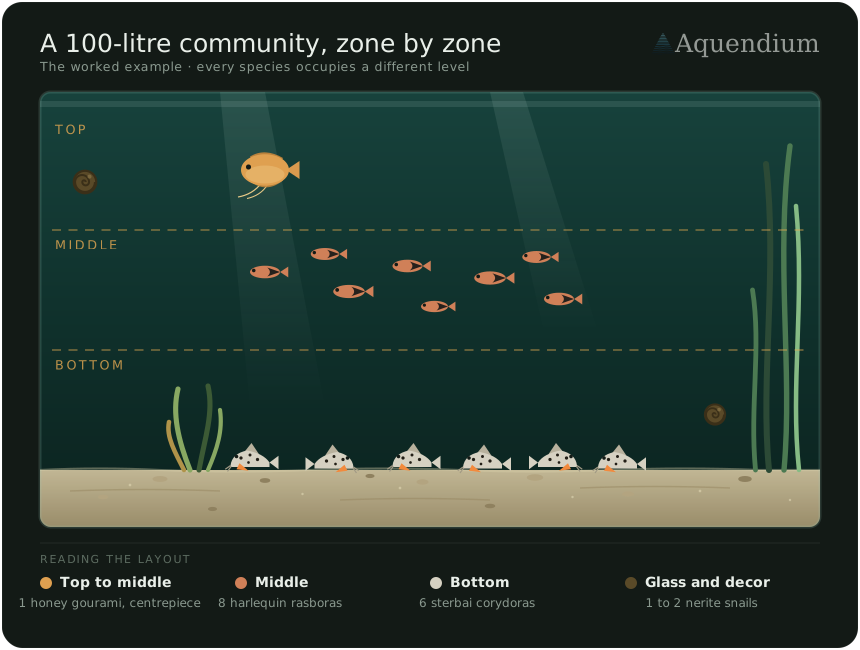
| Fish | Number | Tank zone | Why it works |
|---|---|---|---|
| Honey gourami | 1 | Top to middle | A calm centrepiece with real presence that will not outgrow the tank or bully anyone |
| Harlequin rasbora | 8 | Middle | Hardy, active midwater school that brings movement and colour |
| Sterbai corydoras | 6 | Bottom | Peaceful bottom group that forages the substrate; needs smooth sand or rounded gravel |
| Nerite snail | 1 to 2 | Glass and decor | Tireless algae grazer that cannot breed in fresh water, so it never overruns the tank |
That is a comfortable, not crowded, load for 100 litres, which leaves headroom for stable water and the odd missed water change. Swap in fish that suit your own tap water and taste, then confirm the plan in the stocking calculator before you buy anything. If you want a cleanup crew for a planted tank, cherry shrimp work well too, though a gourami may pick off the occasional shrimplet.
Stock in thirds, not all at once
Even a fully cycled tank is only ready for the waste load it was cycled for. Its bacteria colony is sized to that load, so adding every fish in one trip overwhelms it and triggers a mini-cycle: a fresh spike of ammonia and nitrite that stresses or kills the fish you just bought. The fix is patience.
Add your community in roughly three groups, waiting about two weeks between each:
- Weeks 1 to 4: cycle the tank with no fish in it. Do not skip this. See how to cycle a new aquarium.
- First third (around week 5): add your hardiest, most peaceful group first. In the example above, the 8 harlequin rasboras and the nerite snail, a small starting load.
- Second third (around week 7): once ammonia and nitrite read zero again, add the next group, here the 6 corydoras.
- Final third (around week 9): add the centrepiece last, the honey gourami, so it does not claim the whole tank before the others have settled in.
From a cycled tank, expect 6 to 9 weeks to reach full stocking. Test ammonia and nitrite before each new group and for a week or two afterwards; if anything registers, do a water change and wait longer before the next addition.
Once the tank is fully stocked, settle into a steady routine. Our maintenance schedule covers the daily, weekly, and monthly jobs that keep a stocked community healthy.
Common stocking mistakes
Most stocking problems come back to the same handful of errors. Each is easy to avoid once you know to look for it.
Buying fish on impulse, before planning the whole community
The fish that catches your eye at the shop is rarely the one that fits your tank and your existing stock. Plan the full community on paper (or in the stocking calculator) before you buy anything, and stick to the list. One impulse buy can lock you out of a dozen better choices, or simply not get along with what you already have.
Overstocking, especially all at once
A crowded tank is harder to keep stable, quicker to foul, and more stressful for the fish. Adding a full stock list in one trip is worse still, because it overwhelms the biological filter and causes a mini-cycle. Stock conservatively and add fish in thirds, giving the filter time to catch up between groups.
Keeping schooling fish in twos and threes
A handful of neon tetras or a pair of corydoras looks like a gentle start, but it leaves schooling fish chronically stressed: hiding, drab, and prone to nipping. Buy schooling species in groups of at least 6, and ideally more. If the budget is tight, keep fewer species in proper-sized groups rather than single examples of many.
Ignoring the adult size
The cute juvenile in the shop tank is not the fish you are committing to. Common plecos reach about 60 cm, bala sharks hit 30 cm and need a group and a huge tank, and goldfish grow large, live for over a decade, and are cold-water fish that do not belong in a tropical community at all. Always check the full adult size before buying. For an algae-eater that stays small, a bristlenose pleco (around 12 cm) is the sensible swap.
Mixing incompatible temperaments
Peaceful fish and fin-nippers do not belong together, and long-finned fish like bettas and guppies are magnets for nipping. Semi-aggressive species can work in a community, but only with the right tankmates, enough space, and cover to break up sightlines. When in doubt, build around a single calm centrepiece rather than several pushy ones.
Mixing soft-water and hard-water fish
Every fish shares the same water, so a tank cannot suit both soft-water tetras and hard-water livebearers at the extremes of their ranges, nor cool-water and tropical fish at once. Pick species that all suit the water you already have rather than chasing a compromise. See the best fish for Australian tap water.
Treating a "clean-up crew" as free
Plecos, corydoras, and other bottom-dwellers are sold as algae and leftover eaters, but they are not waste-free recyclers. They still need feeding, they still add bioload, and they count in your stocking total like any other fish. A catfish does not let you skip the maths, or the water changes.
Stocking for Australian tap water
The single biggest factor in what stocks easily for you is your local tap water, and in Australia that varies a lot by region. Working with your water is far easier than fighting it.
Most of the country has hard, alkaline tap water: Brisbane, the Gold Coast, Adelaide, and Perth especially. That suits livebearers (guppies, platies, mollies, swordtails), rainbowfish, many barbs, and snails, which all thrive without any tinkering. Melbourne sits at the soft end, which favours tetras, rasboras, and many of the classic soft-water community fish. Sydney is moderate and gives you the broadest choice of all.
Chasing a different pH or hardness with chemicals is a losing game for a beginner: it is fiddly, easy to get wrong, and dangerous when it swings. Far better to choose a community that suits your water as it comes out of the tap. If you are in a hard-water area and want something a bit different, Australia's own natives are a great fit, the Pacific blue eye and Murray River rainbowfish both relish hard, alkaline water.
Our best freshwater fish for Australian tap water guide matches species to each region in detail, and is the natural next step once you know your water.
Plan your community with the stocking calculator, then see our guides on choosing your first fish, cycling a new aquarium, and the maintenance schedule, or browse the species directory for individual care needs.