Aquarium water parameters explained
What the numbers on your test kit actually mean, what makes each one drift, and the ranges to aim for in a healthy freshwater tank.
Published 6 June 2026 · Last updated 21 June 2026 · 14 min read
What "water parameters" actually means
"Water parameters" is shorthand for the measurable chemical and physical properties of the water in your tank. Healthy fish depend on these values staying within the range their species can tolerate, and on those values being stable rather than swinging up and down.
Two truths about parameters matter more than any single number:
Stability matters more than perfection. A tank steady at pH 7.8 is healthier than one bouncing between pH 6.8 and 7.4, even though the second range includes "better" values. Fish adjust to consistent water over weeks; sudden shifts cause stress, illness, and death even when the new values are technically "ideal."
Your tap water is your starting point. Every parameter conversation has to begin with what comes out of your tap, because you will replace about 25% of your water with it every week. Fish that do not match your tap water are fish you will be fighting your tap water to keep, every water change, for the life of the tank. Choosing species suited to your local water is the single biggest decision a beginner makes.
How to test, and how often
You need a liquid freshwater test kit, not test strips. Strips are imprecise: they read broad ranges rather than specific values, and the colour matching is unreliable at the low concentrations that matter most. The API Freshwater Master Test Kit is the most widely used kit in the hobby and stocks in almost every Australian aquarium shop. It covers pH, ammonia, nitrite, and nitrate. Hardness kits (GH and KH) are sold separately.
For a stable, established tank, test:
- Weekly for nitrate (before each water change, as a sanity check).
- Monthly for pH, KH, and GH (more often if you suspect a problem).
- Only when needed for ammonia and nitrite in a cycled tank. They should always read zero, so test them when something looks wrong or after disturbing the cycle, not on a routine.
For a new, uncycled tank, test ammonia, nitrite, and nitrate daily until the cycle is established. See our cycling guide for the full detail.
Temperature
This is the easiest parameter to control and one of the most important. Tropical fish need warm, stable water; cold-water fish need cool, stable water; and mixing the two rarely works.
Typical target ranges:
- Tropical community tanks: 24 to 26°C
- Discus and other warm-water specialists: 27 to 30°C
- Cold-water tanks (goldfish, white cloud minnows): 18 to 22°C
The mistake beginners make is rarely picking the wrong number; it is letting the temperature swing. A heater that drifts between 23°C and 27°C across a day is more stressful than one holding steady at 25°C, even though the averages match. A good thermostat-controlled heater, plus a thermometer mounted on the opposite side of the tank from the heater (so you measure water that has actually circulated, not the warm spot beside the element), keeps things steady.
To size a heater to your tank, use our heater wattage calculator.
pH
pH measures how acidic or alkaline your water is, on a scale from 0 to 14:
- 7 is neutral
- below 7 is acidic
- above 7 is alkaline
Most freshwater fish live somewhere in the range 6.0 to 8.0 in the wild, and the species you keep should match where they come from in that range.
One thing to know: each whole step on the pH scale is a tenfold change. pH 6 is ten times more acidic than pH 7, and pH 5 is a hundred times more acidic than pH 7. So a small change in the number is a large change in the water.
Typical target ranges:
- Soft-water species (most tetras, rasboras, discus, dwarf cichlids): pH 6.0 to 7.0
- Mid-range community tanks: pH 6.8 to 7.5
- Hard-water species (guppies, platies, livebearers, African rift lake cichlids, snails): pH 7.5 to 8.5
pH is closely tied to your tank's buffering capacity, which is the water's ability to resist pH changes (see the KH section below). Tanks with low buffering can have their pH crash quickly as acid builds up between water changes, a problem known as "old tank syndrome." Tanks with high buffering resist pH changes more strongly. This is why some keepers find their pH stubbornly refuses to budge while others find it bouncing every week.
Ammonia (NH3/NH4+)
Ammonia is the most acutely toxic of the common parameters and the one that kills fish fastest. It enters the tank as fish waste, decomposing food, and decaying plant matter, and beneficial bacteria convert it into nitrite (the next parameter down).
Target: 0 ppm, always, in a cycled tank.
Any detectable ammonia in an established tank means something is wrong: a fish has died and is decomposing, the filter has crashed, you have overstocked, the filter media has been over-cleaned, or you have added too many fish at once.
Ammonia's toxicity depends heavily on pH and temperature. In acidic water, most of it exists as the relatively harmless ammonium ion (NH4+). In alkaline water, more of it exists as the highly toxic free ammonia (NH3). So the same 1 ppm reading is far more dangerous at pH 8.0 than at pH 6.5. Australia's mostly alkaline tap water makes ammonia management slightly more critical here than in soft-water regions.
Nitrite (NO2-)
Nitrite is the second stage of the nitrogen cycle: bacteria convert ammonia to nitrite, then a different group convert nitrite to nitrate. Nitrite is also acutely toxic, though slightly less so than ammonia.
Target: 0 ppm, always, in a cycled tank.
Nitrite causes "brown blood disease": it binds to the fish's blood and blocks oxygen transport, slowly suffocating the fish even in well-aerated water. Signs include gasping at the surface, listlessness, and red or brown gill colour.
Any nitrite reading above zero in an established tank points to the same problems as detectable ammonia, usually meaning the cycle has been disrupted. The fix is the same: a large water change, dose Seachem Prime, and find the cause (often filter cleaning in chlorinated tap water, a power outage, or heavy overstocking).
A small dose of aquarium salt (1 tablespoon per 20 litres) is sometimes used short-term to reduce nitrite toxicity during a crisis, because the chloride competes with nitrite at the gills. This is an emergency measure only, and it is not suitable for shrimp or certain catfish.
Nitrate (NO3-)
Nitrate is the final stage of the nitrogen cycle and the only one that is relatively safe at low levels. It builds up in the tank until you remove it through water changes (or via live plants, which use it as fertiliser).
Target ranges:
- Below 20 ppm: excellent. Easily achieved in lightly stocked, well-planted tanks with weekly water changes.
- 20 to 40 ppm: acceptable for most fish. Most healthy community tanks sit here.
- Above 40 ppm: increase water changes. Long-term exposure suppresses fish immunity and growth, and is especially bad for shrimp and breeding fish.
- Above 80 ppm: dangerous. Sustained levels here cause chronic stress, poor breeding, and visible decline over months.
If your nitrate keeps rising despite regular water changes, your options are: change water more often or in larger amounts, add live plants, reduce stocking, or reduce feeding. Note also that some Australian tap water already contains nitrate (typically 5 to 15 ppm), especially in agricultural areas. You cannot get below your tap water's nitrate level with water changes alone; only plants or reverse osmosis (RO) water will remove what is already there.
General hardness (GH)
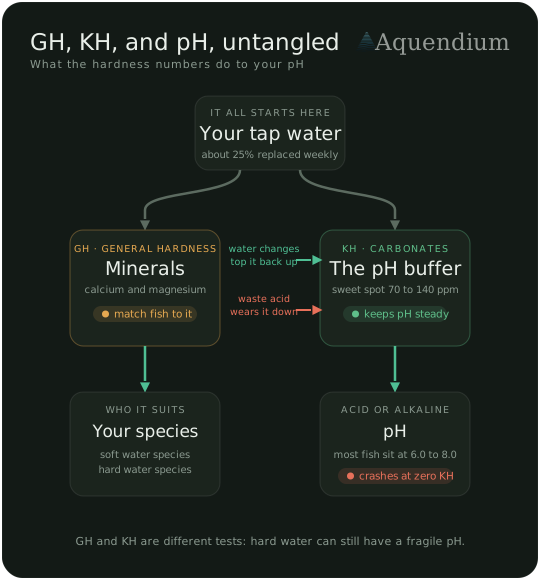
GH measures the dissolved minerals (mainly calcium and magnesium) in your water. It is what makes water "hard" or "soft" in the kitchen sense.
GH is measured in parts per million (ppm) or degrees of general hardness (dGH). The conversion is 1 dGH to 17.86 ppm, and our hardness converter does it both ways. Australian water is usually reported in ppm; European hobby resources often use dGH.
Categories:
- Very soft: 0 to 70 ppm (0 to 4 dGH): South American blackwater species (discus, soft-water tetras, wild bettas)
- Soft: 71 to 140 ppm (4 to 8 dGH): most community tetras, rasboras, and corydoras
- Moderate: 141 to 210 ppm (8 to 12 dGH): broad community range
- Hard: 211 to 320 ppm (12 to 18 dGH): livebearers (guppies, platies, mollies) and snails
- Very hard: 321 to 530 ppm (18 to 30 dGH): African rift lake cichlids and other hard-water specialists
GH affects fish in two ways. Practically, soft-water species are built for low-mineral water and struggle to manage their internal salt balance in mineral-rich water (and the reverse is true for hard-water species). Behaviourally, fish show their best colour, breed most readily, and live longest in water that matches their natural conditions.
Australian tap water ranges from very soft to very hard by region, which strongly affects species selection. See the Australian section below.
GH matters for invertebrates as much as fish: shrimp and snails draw on its calcium to build their shells and to moult, so water that is too soft leads to failed moults and pitted shells. Our guide to keeping freshwater shrimp covers this in detail.
Carbonate hardness (KH)
KH measures the carbonates and bicarbonates in your water: the chemicals that buffer pH against change. High KH means stable pH that resists swings. Low KH means pH that can drift or crash easily.
KH is also usually measured in ppm or in degrees (dKH), with the same conversion as GH: 1 dKH to 17.86 ppm.
Functional ranges:
- Very low KH (0 to 35 ppm / 0 to 2 dKH): pH unstable and prone to crashes. Needs careful monitoring and frequent small water changes. Suitable only for advanced keepers maintaining specific blackwater conditions.
- Low KH (35 to 70 ppm / 2 to 4 dKH): the soft-water community range. Stable enough for most peaceful species, but still needs attention.
- Moderate KH (70 to 140 ppm / 4 to 8 dKH): the broad sweet spot for most community tanks. Stable pH, easy to maintain.
- High KH (140+ ppm / 8+ dKH): very stable, hard to shift. Good for hard-water and African cichlid setups.
KH and pH are linked. As KH falls (typical in tanks with infrequent water changes), the water's buffering erodes and pH starts to drift down. This is the most common cause of "old tank syndrome": a gradual decline that fish seem to tolerate until they suddenly do not.
Regular water changes restore KH from your tap water's baseline. If your tap water itself is very low in KH, you may need to supplement with crushed coral, aragonite, or a commercial KH buffer to keep things stable.
Dissolved oxygen
Fish breathe oxygen from the water through their gills, and everything in the tank (including the beneficial bacteria) uses oxygen continuously. Most well-maintained community tanks have plenty without any special effort, but several things can deplete it dangerously fast.
You generally do not measure dissolved oxygen directly. Instead, watch for the warning signs of low oxygen:
- Fish gasping at the surface, particularly in the morning
- Faster gill movement and breathing
- Reduced activity, especially during the warmest part of the day
- Fish gathering near filter outputs, where the flow oxygenates the water
Things that reduce dissolved oxygen:
- Warm water: oxygen dissolves less readily above 28°C, which is why discus and other warm-water species need particularly strong aeration
- Overstocking: more fish means more oxygen consumed
- Poor surface movement: gas exchange happens at the surface, so a still surface limits how much oxygen gets in
- Heavy waste load: decomposing waste consumes oxygen as it breaks down
- Plants at night: plants produce oxygen during the day but consume it at night, which is why heavily planted tanks sometimes see fish gasping in the morning
The simplest fix for low oxygen is surface movement: angle your filter return upward so it ripples the surface, or add an air stone. CO2-injected planted tanks need a careful balance between CO2 and oxygen, particularly overnight when the CO2 should be switched off.
Australian tap water: what to expect
Australian tap water varies a lot by region, but a few general patterns affect species selection across most of the country. For which fish suit each region, see our best freshwater fish for Australian tap water guide.
South East Queensland (Brisbane, Gold Coast, Sunshine Coast): soft to moderate in hardness but alkaline (GH 120 to 180 ppm, pH 7.5 to 8.0), with moderate to high KH. The alkaline pH suits livebearers, snails, and most community fish; genuinely hard-water specialists like African cichlids do better in harder Adelaide or Perth water. Difficult for soft-water tetras, discus, and shrimp without modification.
Sydney and surrounds: very soft to soft (GH 50 to 100 ppm), slightly alkaline (around pH 7.5). The most flexible Australian water: it supports a broad range of species without much modification.
Melbourne: very soft (GH around 10 to 30 ppm) and slightly acidic to neutral. Excellent for soft-water community species, tetras, and discus. Challenging for livebearers and snails without supplementation.
Adelaide: moderate to hard and alkaline, harder than South East Queensland.
Perth: very hard tap water in most areas. Best for hard-water species.
Chloramine is now the main disinfectant in most Australian water supplies, which means a dechlorinator is non-negotiable: chlorine evaporates if water is left to stand, but chloramine does not. Seachem Prime handles both chlorine and chloramine and is the most widely used dechlorinator in Australian fishkeeping.
Troubleshooting common parameter problems
My pH keeps dropping
Almost always a KH problem. Test your KH. If it is low, the water has no buffering left and is turning acidic as acid builds up between water changes. Fix: larger or more frequent water changes to restore KH from your tap water, or add crushed coral to the filter for extra carbonate buffering.
My nitrate won't go down despite weekly water changes
Two possibilities. Your tap water might already contain nitrate (test it directly: fill a glass from the tap, let it sit briefly, then test). Or your stocking and feeding are producing nitrate faster than weekly 25% changes can export it. Options: larger water changes, more plants, less food, less stocking.
I have ammonia readings in a tank that's been cycled for months
Something disrupted the cycle. Common causes: filter media cleaned in tap water (kills bacteria), a fish died and is decomposing out of sight, medication was added (some antibiotics destroy the nitrogen cycle), or stocking was increased too quickly. Immediate response: large water change, dose Seachem Prime, find and remove any dead fish, and leave the filter alone.
My fish are gasping at the surface every morning
Low overnight oxygen. In planted tanks, plants consume oxygen at night; in heavily stocked tanks, the fish outpace oxygen production. Add surface movement (angle the filter output up, or run an air stone on a timer overnight).
My GH and KH are very different from each other
This is normal. GH measures total dissolved minerals; KH measures only the carbonate and bicarbonate part. Water can be high in GH but low in KH (common with some bore water), which means hard water that still has unstable pH. Treat the KH separately by adding a carbonate buffer if needed.
I added pH-adjusting chemicals and now everything is worse
Stop adding more. Most pH-adjusting products work by adding acids or bases that get used up within days, causing rebound swings. Stop dosing, do several 25% water changes over the next week to restore your tap-water baseline, and choose species suited to that baseline rather than fighting it.
For complete tank setup from scratch, see how to set up a new aquarium. For choosing fish suited to your water, see how to choose your first fish. For ongoing maintenance, see water changes. If your fish look unwell, see common fish diseases.