Choosing the best aquarium substrate
The layer on your tank floor does far more than look good. It houses beneficial bacteria, anchors plants, shapes how your fish behave, and can even shift your water chemistry. Here is how to match it to your fish and your tank, and the mistakes that are hard to undo later.
Published 18 June 2026 · Last updated 18 June 2026 · 14 min read
Why substrate matters more than it looks
Substrate is usually chosen last and cheapest, which is backwards. It is one of the few decisions that is genuinely hard to change once the tank is running, and it quietly affects four things that matter.
Biological filtration. Every grain is surface area for the beneficial bacteria that process fish waste. A mature substrate is part of your biological filter, which is one reason you never replace all of it at once. If you are new to that process, start with our guide to cycling a new aquarium.
Plants. Rooted plants draw nutrients from the substrate and need something they can anchor in. The right bed is the difference between plants that spread and plants that float loose or starve.
Fish behaviour and welfare. Corydoras sift mouthfuls of sand through their gills to forage, kuhli loaches burrow into it to feel safe, and most fish are calmer and more colourful over a dark floor. The wrong substrate can injure fish or leave them permanently stressed.
Water chemistry. Some substrates are inert and change nothing. Others are active: crushed coral and aragonite slowly raise hardness and pH, while many planted soils gently soften and acidify the water. That can be a feature or a problem depending on your fish (see our water parameters guide).
The main substrate types, compared
There are really only a handful of categories. Almost every product is a version of one of these.
Fine smooth gravel
The classic, cheap, beginner-friendly choice. It is inert, so it changes nothing about your water, lasts forever, and lets waste be vacuumed out easily during water changes. The downsides: food and waste fall down between the grains, and it grows nothing on its own, so demanding plants need root tabs. Choose a small grain (2 to 5 mm) with rounded edges. Best for general community tanks.
Sand
Natural-looking and the best floor for bottom-dwellers. Waste sits on top where you can see and remove it rather than sinking in, and sand-sifting and burrowing species need it to behave naturally. The trade-offs: very fine sand can compact over time, a light-coloured sand shows every speck of detritus, and a new sand bed will be stirred up into the filter until it settles. Best for bottom-dweller tanks, biotopes, and shrimp.
Planted aquarium soil (aqua soil)
Nutrient-rich, baked clay granules made for plant growth, such as Fluval Stratum, Tropica Aquarium Soil, and ADA Aqua Soil. They grow demanding plants superbly and actively soften and buffer the water toward the soft, acidic side, which suits many tetras, rasboras, and dwarf cichlids. The catch: they are expensive, they break down and need replacing every one to three years, they lower KH (so watch pH stability), and fresh soil often leaches ammonia for the first few weeks. Best for planted and aquascaped tanks, especially soft-water ones.
Inert planted gravels
Clay-based gravels like Seachem Flourite and CaribSea Eco-Complete hold nutrients for plant roots but do not alter your water chemistry and last indefinitely. They are a good middle path for a long-term planted tank when you do not want the chemistry shift of aqua soil. They are dustier to rinse and a little coarser than sand, so pair them with a sand cap if you keep corydoras.
Crushed coral and aragonite
Calcium-carbonate substrates that slowly dissolve to raise general hardness (GH), carbonate hardness (KH), and pH, and hold them there. This is exactly right for African rift lake cichlids, for livebearers and snails in soft water, and anywhere you want a stable hard, alkaline tank. It is exactly wrong for soft-water species. You can also mix a little into another substrate, or run it in the filter, to nudge hardness up gradually (our hardness converter helps you read the numbers).
Bare bottom
No substrate at all. It looks stark and gives plants nothing to root in, but it is spotless and effortless to keep clean, with nowhere for waste or leftover medication to hide. That makes it the standard choice for fry grow-out tanks, breeding setups, and hospital or quarantine tanks.
Match the substrate to your fish
Your fish make some of this decision for you. A few groups have real substrate needs rather than preferences.
Bottom-dwellers: sand, and nothing sharp
This is the one rule that is not negotiable. Sand-sifters and burrowers have soft, sensitive barbels and skin that sharp or coarse gravel grinds down, leading to eroded barbels and infection. Give them smooth sand or, at most, fine rounded gravel. This applies to bronze corydoras, pygmy corydoras, kuhli loaches (which bury themselves completely), and dwarf chain loaches. On sand they sift and dig the way they are built to; on sharp gravel they slowly wear their barbels away.
Shy and colourful fish: go dark
Many of the most striking community fish come from shaded, tannin-stained water and only show their full colour over a dark floor. A pale substrate makes them feel exposed, so they stay drab and hide. A dark sand or soil brings out the best in neon tetras, ember tetras, chili rasboras, harlequin rasboras, scarlet badis, celestial pearl danios, and the German blue ram.
Snails and hard-water fish: mind the minerals
Snails build their shells from calcium, and in soft, low-mineral water those shells slowly pit and dissolve. This is why mystery snails, nerite snails, and rabbit snails need mineral-rich water to stay healthy. Livebearers such as guppies, platies, and Endler's livebearers share that preference. If your tap water is naturally hard and alkaline, an inert sand or gravel is all you need; if it is soft, a crushed-coral or aragonite substrate will keep them in good health. African rift lake cichlids like the electric yellow cichlid need the same hard, alkaline chemistry and love to dig, so an aragonite sand suits them perfectly.
Shrimp: fine, planted, and matched to the type
Shrimp graze the biofilm that grows on substrate, so a fine bed with plenty of moss and surface area suits them. The type matters: cherry shrimp (Neocaridina) prefer neutral to hard water and do best on an inert sand or gravel, never an acidifying soil, while crystal and other Caridina shrimp want the soft, acidic conditions an active aqua soil creates. Amano shrimp are unfussy and happy on either.
Bettas and centrepiece fish
Some fish simply are not bothered. A betta will accept any smooth sand or gravel, though a dark floor shows off its colour. A bristlenose pleco cares far less about the substrate than about having driftwood to rasp on, and produces enough waste that an easy-to-vacuum floor helps.
Match the substrate to your tank type
If you are planning around a style of tank rather than one species, this is the quick map.
| Tank type | Best substrate | Why |
|---|---|---|
| Standard community | Fine smooth gravel or aquarium sand | Cheap, inert, and easy to maintain; suits the widest range of fish |
| Low-tech planted | Sand or fine gravel with root tabs, or an inert planted gravel | Feeds roots without the cost or chemistry shift of aqua soil, and lasts indefinitely |
| High-tech / aquascape | Nutrient aquarium soil (aqua soil) | Best growth for demanding plants and carpets; buffers soft, acidic water |
| Blackwater / soft biotope | Dark fine sand with leaf litter, or aqua soil | Creates the soft, acidic, shaded look and chemistry, and shows fish colour |
| Shrimp tank | Cherry shrimp: inert fine sand or gravel with moss. Crystal shrimp: buffering aqua soil | Neocaridina want neutral to hard water; Caridina want soft and acidic |
| Hard-water / African cichlid | Aragonite or crushed-coral sand | Raises and holds hardness and pH, and is safe for diggers |
| Fry, breeding, hospital | Bare bottom | Spotless and easy to clean, with nowhere for waste or medication to collect |
Not sure which fish suit your local water before you commit to a chemistry-shifting substrate? Our guide to the best freshwater fish for Australian tap water matches species to region, and the choosing your first fish guide covers the rest.
How much, and how deep
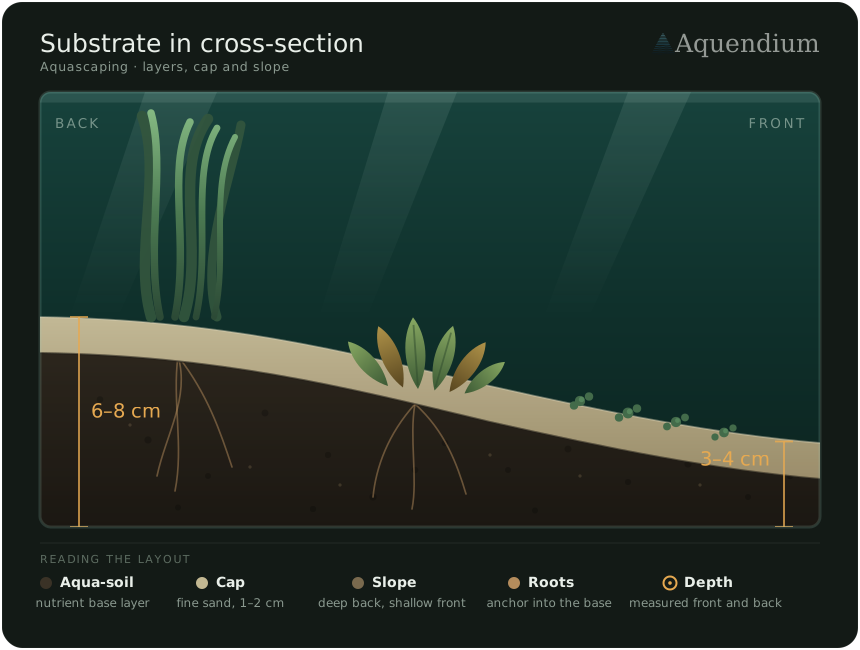
For most tanks, aim for 3 to 5 cm of substrate, sloped a little higher toward the back to add a sense of depth. Heavily planted tanks and carpeting plants want a bit more, up to 6 to 8 cm at the back, to give roots room. Keep sand beds on the shallower side (around 3 to 4 cm), because a very deep, undisturbed sand bed can trap pockets of gas. Bare-bottom tanks obviously need none.
The quickest way to work out how much to buy is our substrate calculator: enter your tank's floor dimensions and bed depth, pick gravel, sand, or soil, and it gives you the volume, the weight, and how many bags to get. To do it by hand, multiply the tank's length by its width by your target depth, all in centimetres, then divide by 1000 to get the volume in litres. Allow roughly 1.5 kg per litre for sand or gravel. A 60 by 30 cm floor at 5 cm deep is 9 litres, or about 13 to 14 kg, so a 15 kg bag covers it with a little spare. (The length and width are the same figures you would enter in our tank volume calculator.)
Preparing and adding it
Get this right on day one and you avoid days of cloudy water.
Rinse gravel and sand until the water runs clear. Both ship with a surprising amount of fine dust. Rinse a few kilograms at a time in a bucket or colander before it goes in. The one exception is aqua soil: do not rinse it, as that destroys the granules. It is meant to go in dry.
Add substrate before water. Spread it across the empty tank, then fill slowly by pouring onto a plate or bowl so the stream does not blast craters. This follows the same sequence as our full setup walkthrough.
Consider capping. If you want the growth of a nutrient soil but the look of sand, or you keep corydoras that would otherwise dig into the soil, lay a thin 1 to 2 cm cap of sand or fine gravel over the top. The same trick lets you use cheap garden soil as a planted base, capped so it stays put.
Expect some cloudiness with sand. Fine sand will haze the water and may get drawn toward the filter intake for the first day or two. Raise the intake slightly until it settles, and the haze clears on its own.
Buying substrate in Australia
You have good cheap options locally, alongside the specialist products.
Pool-filter sand is the budget favourite: a clean, inert silica sand sold in 20 kg bags at pool shops and hardware stores for a fraction of the price of aquarium-branded sand. Rinse it well and it is excellent for community and bottom-dweller tanks. Play sand from a hardware store is cheaper again but finer and dustier, and it compacts more easily, so check it is plain washed sand with no additives and rinse it thoroughly.
Avoid beach sand (salt, and illegal to remove from many beaches), and builder's or brickies' sand, which is too fine and can carry lime that shifts your hardness unpredictably. Be wary of brightly coated or dyed gravels, which can fade and look artificial.
For planted and specialist tanks, aquarium shops and online retailers stock the aqua soils, inert planted gravels, crushed coral, and aragonite named above. A bag of aqua soil costs far more than pool-filter sand, so it is worth being sure you want the plant growth and the chemistry change before paying for it.
Common substrate mistakes
- Sharp gravel under bottom-dwellers. The most common avoidable injury in the hobby. Corydoras and loaches need smooth sand or rounded gravel, full stop.
- Adding fish to fresh aqua soil. New soil leaches ammonia. Cycle the tank first, every time.
- Accidental hardness changes. Crushed coral, limestone gravel, or shell grit in a soft-water tank will quietly push your hardness and pH up and undo a careful soft-water setup.
- Too little for plants. A 1 cm scatter will not hold rooted plants. Give them 5 cm or more to anchor in.
- Vacuuming sand like gravel. You hover the siphon just above sand to lift waste off the top, rather than digging into it as you would with gravel. See our water changes guide for the technique, and the reminder not to dig into planted root zones.
- Treating it as easy to swap. Replacing substrate in a stocked tank means tearing the tank down and disturbing your biological filter. Choose once, for the long term.
Substrate is one part of a healthy tank. See our guides on how to set up a new aquarium, water parameters, and water changes, and browse the species directory for the fish that suit your setup.